
How to Highlight Your Unique Selling Points and Pre-Qualify Leads
If you’re running Google Ads and getting clicks but not conversions, sometimes the issue may not be the traffic, but the messaging.
Many businesses in Kenya write ad descriptions that are too generic:
- “High quality services”
- “Affordable prices”
- “Contact us today”
That’s not persuasive and is likely to attract the wrong clicks. A strong Google Ads description does two critical things:
- It convinces the right person to click
- It discourages the wrong person from clicking
That second part is where most of us fail.
This guide breaks down how to write Google Ads descriptions that:
- Clearly communicate your unique selling points (USPs)
- Set expectations early to filter out low-quality leads
- Improve your conversion rate and ROI
Why Your Ad Description Matters More Than You Think
In Google Ads, you’re paying per click. That means every unqualified click is wasted money. Your description is not just “extra text.” It’s your filter and qualifier.
A well-written description:
- Pre-sells your offer before the user even lands on your site
- Aligns expectations (price, quality, audience)
- Reduces irrelevant inquiries
- Increases conversion rates
A weak description:
- Attracts everyone → converts almost no one
- Leads to price shoppers, time-wasters, and mismatched clients
You don’t want more clicks. You want better clicks.
What Makes a Google Ads Description Persuasive?
A persuasive description combines three elements:
1. Clear Value
What do you actually offer, and why should someone care?
2. Differentiation
Why should they choose you over competitors?
3. Qualification
Who is this for, and just as importantly, who is it not for?
If your ad doesn’t include all three, you’re leaving money on the table.
How to Identify Your Unique Selling Points (USPs)
Before you write anything, get clear on your real advantage.
Most businesses default to weak USPs like:
- “Quality service”
- “Professional team”
- “Affordable pricing”
These are not persuasive because everyone says them.
Strong USPs Are Specific and Verifiable
Ask yourself:
- What do we do better than competitors?
- What do customers consistently mention in reviews?
- What problem do we solve faster or more efficiently?
- What makes us different in the Kenyan market?
Examples of Strong USPs (Kenyan Context)
Instead of:
Affordable web design
Say:
Custom websites from KES 35,000 Built for Kenyan SMEs
Instead of:
Reliable safari tours
Say:
Locally operated safaris with certified guides and 24/7 ground support
Instead of:
Fast delivery
Say:
Same-day delivery in Nairobi for orders placed before 2PM
Specific = believable = persuasive
Structuring a High-Converting Google Ads Description
Your description should follow a simple, effective structure:
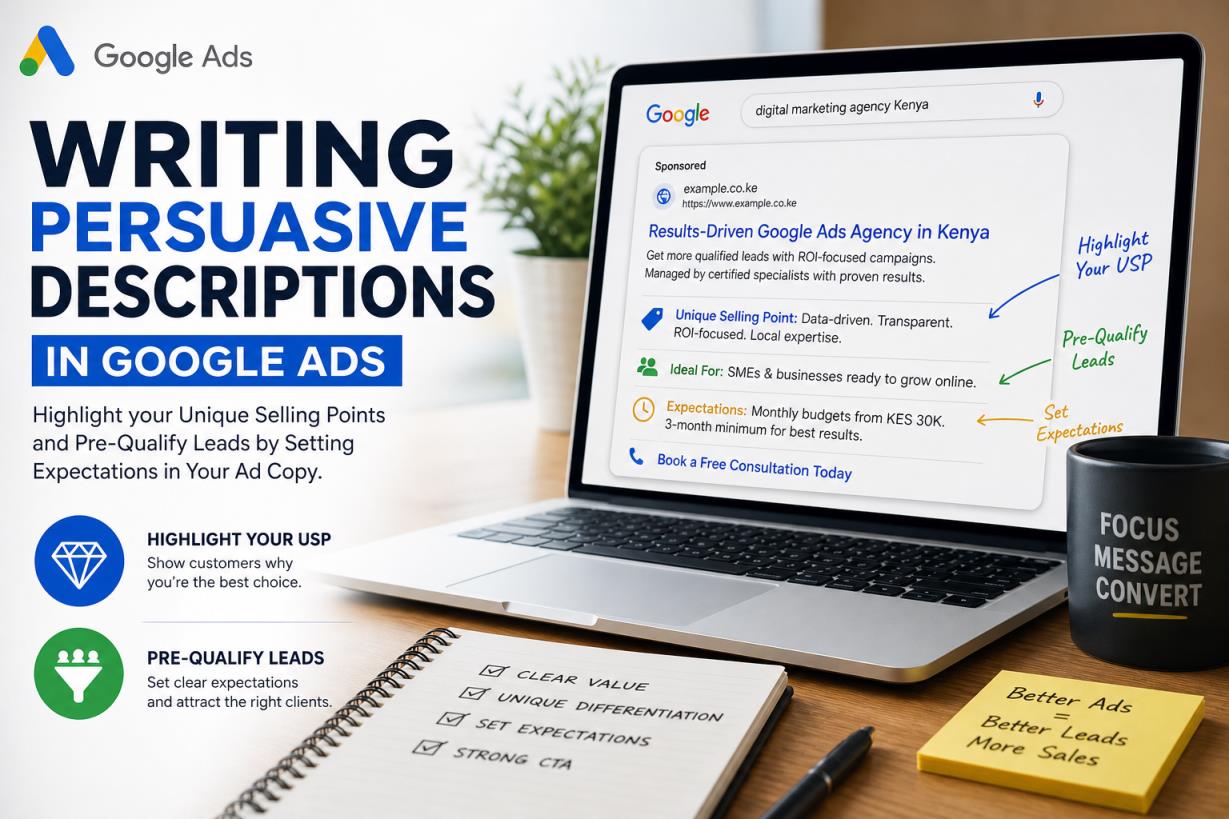
1. Lead With the Core Benefit
Start with what the customer gets—not what you do.
❌ “We offer digital marketing services”
✅ “Get more qualified leads with data-driven Google Ads campaigns”
2. Add Your Unique Selling Point
This is where you differentiate.
Example:
Managed by certified specialists with proven ROI in Kenyan markets
3. Set Expectations (Pre-Qualify)
This is the part most people skip.
Example:
Ideal for businesses ready to invest from KES 30K/month
4. Include a Clear Call to Action (CTA)
Tell them what to do next.
Examples:
Book a free consultation
Get a quote today
Speak to our team
How to Pre-Qualify Leads Using Ad Copy
This is where you gain a serious competitive advantage. Pre-qualifying means intentionally filtering your audience so that only the right people click. It sounds counterintuitive, but it’s powerful.
Why Pre-Qualification Works
When you set expectations:
- You repel unqualified leads
- You attract serious buyers
- You reduce wasted ad spend
- You increase close rates
What to Include When Pre-Qualifying
1. Pricing Signals
You don’t always need exact prices, but you should hint at positioning.
Examples:
“Packages from KES 50,000”
“Premium safari experiences”
“Budget-friendly options available”
This helps filter:
- Bargain hunters vs serious buyers
- Low budget vs high intent clients
2. Target Audience Clarity
Be explicit about who your service is for.
Examples:
“For SMEs looking to scale online”
“Ideal for corporate travel planners”
“Designed for first-time home buyers in Kenya”
This improves relevance instantly.
3. Service Scope
Set boundaries to avoid mismatched expectations.
Examples:
“Custom builds only – no templates”
“Fully managed services – no DIY options”
“Nairobi-based delivery only”
4. Timeline Expectations
This reduces friction later.
Examples:
“Delivery in 7–14 days”
“Same-day response guaranteed”
“Limited slots available weekly”
Examples of Weak vs Strong Ad Descriptions
Let’s make this practical.
Example 1: Web Design
Weak:
Professional web design services. Affordable pricing. Contact us today.
Strong:
Custom websites for Kenyan SMEs from KES 35K. Built for conversions, not just design. Book a free consultation today.
Example 2: Safari Business
Weak:
Best safari packages in Kenya. Affordable tours. Book now.
Strong:
Guided Kenya safaris with local experts. Small groups, personalized itineraries. Ideal for international travelers. Enquire today.
Example 3: Airbnb Management
Weak:
Airbnb management services in Nairobi. Call us today.
Strong:
Full-service Airbnb management for busy hosts. Increase occupancy & reviews. Nairobi properties only. Get started today.
Writing Formulas You Can Use Immediately
If you’re serious about improving your ads, use these formulas.
Formula 1: Benefit + USP + Qualification + CTA
Get [RESULT] with [USP]. Ideal for [TARGET]. [CTA]
Example:
Get more bookings with professionally managed Airbnb listings. Ideal for Nairobi hosts. Start today.
Formula 2: Problem + Solution + Differentiation
Struggling with [PROBLEM]? We offer [SOLUTION] with [USP].
Example:
Struggling to get leads online? We run ROI-focused Google Ads for Kenyan SMEs.
Formula 3: Offer + Constraint (Qualification)
[OFFER]. Starting from [PRICE] / Limited to [AUDIENCE].
Example:
Custom websites starting from KES 40K. For businesses ready to scale online.
Common Mistakes That Kill Ad Performance
Let’s be direct—these mistakes are costing you money.
1. Being Too Generic
If your ad could apply to any business, it’s weak.
2. Trying to Appeal to Everyone
When you target everyone, you convert no one.
3. Hiding Important Details
If pricing, location, or scope matters, say it early.
4. Overpromising
Claims like “#1 in Kenya” without proof reduce trust.
5. Ignoring Local Context
Your messaging should reflect:
- Kenyan pricing expectations
- Local geography (Nairobi, Mombasa, etc.)
- Market maturity
Advanced Tip: Align Your Ad With Your Landing Page
Your ad is not isolated, it’s part of a funnel. If your ad says:
“Packages from KES 50K”
Your landing page must reflect that. Misalignment leads to:
- High bounce rates
- Low conversions
- Poor Quality Score
Consistency builds trust.
How to Test and Improve Your Ad Descriptions
You don’t get this perfect on day one. You test.
What to Test
- Different USPs
- Pricing signals vs no pricing
- Target audience phrasing
- CTA variations
What to Track
- Click-through rate (CTR)
- Conversion rate
- Cost per lead
- Quality of inquiries
Simple Testing Approach
Run 2–3 variations at a time:
- Same headline
- Different descriptions
Pause underperformers quickly.
Real-World Strategy for Kenyan Businesses
If you’re running ads with a limited budget (which most SMEs are), your priority is:
Efficiency, not volume. That means:
- Fewer clicks
- Higher intent
- Better conversion
- Your Focus Should Be:
- Clear positioning (premium vs budget)
- Strong qualification (who it’s for)
- Honest messaging (no fluff)
This is how you compete against bigger brands.
Most businesses treat Google Ads descriptions as an afterthought. That’s a mistake. Your description is:
- Your first filter
- Your first sales pitch
- Your cost control mechanism
If you improve just this one element, you will:
- Reduce wasted spend
- Attract better clients
- Increase conversions
Be specific. Be clear. Be selective.