

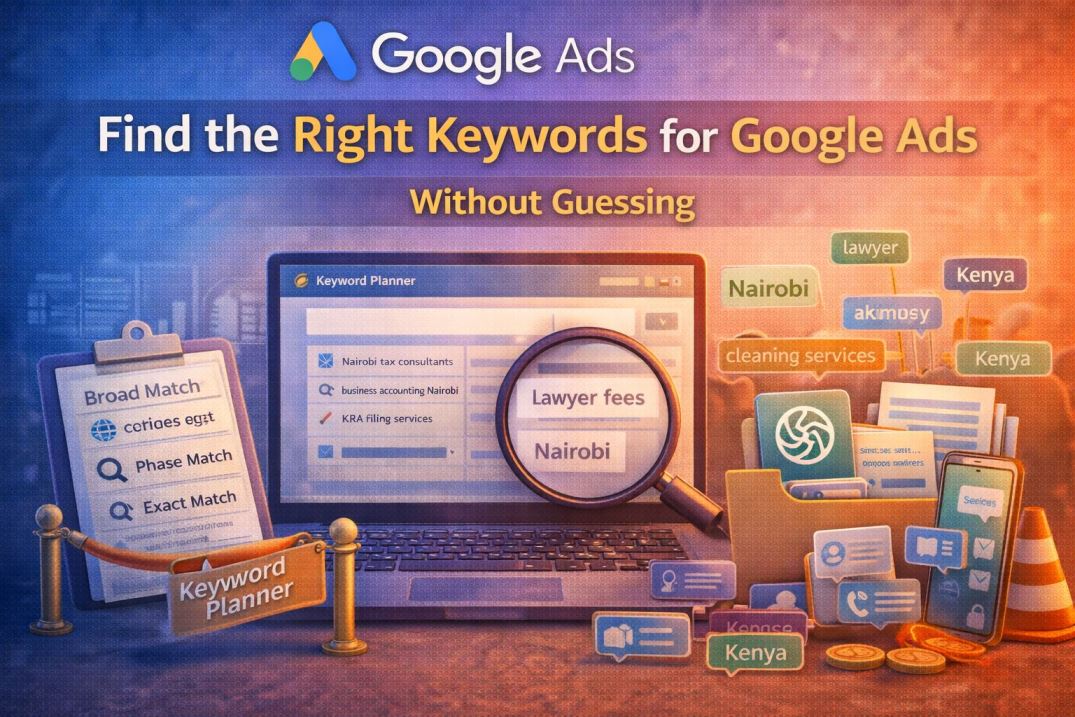
If you are running Google Ads for your business in Kenya, your results are directly tied to one thing:
The quality of your keywords.
Many SMEs either:
- Guess keywords based on what they think customers search
- Copy competitors blindly
- Or rely entirely on automation
The result?
Wasted budget. Weak leads. Frustration.
This guide will show you how to properly use:
- Google Keyword Planner
- Match types
- AI tools
- First-party customer data
To build smarter, more profitable campaigns.
Step 1: Start with Google Keyword Planner (Not Your Imagination)
Before using AI or advanced tools, start with data.
Inside Google Ads, Keyword Planner shows you:
- Real search volumes
- Competition levels
- Suggested bid ranges
- Related keyword variations
For example, if you are a Nairobi-based accountant, don’t just use:
accountant Nairobi
Keyword Planner may reveal searches like:
- tax consultant Nairobi
- KRA filing services
- bookkeeping services Kenya
- business tax help Nairobi
These are not guesses.
These are real search behaviours.
Data first. Assumptions second.
Step 2: Understand Match Types (This Is Where Many SMEs Go Wrong)
Choosing the wrong match type can either:
- Starve your campaign
- Or make it too loose and expensive
Here’s a simplified explanation:
Broad Match
Google has flexibility to show your ad for related variations.
Good for:
- Gathering data
- Larger budgets
- Mature accounts
Risk:
You may attract irrelevant traffic if not monitored carefully.
Phrase Match
Your ad shows when the search includes your phrase in order.
Good for:
- Controlled growth
- SMEs with moderate budgets
- Better intent alignment
Exact Match
Your ad shows for very specific searches.
Good for:
- Small budgets
- High-intent targeting
- Testing specific buyer terms
For most Kenyan SMEs starting out:
Phrase + Exact match is usually safer.
Broad match should be used carefully and supported by strong negative keywords.
Step 3: Use AI — But Don’t Replace Real Data
AI tools like ChatGPT can dramatically speed up research.
You can ask:
- “List high-intent keywords for a cleaning company in Nairobi.”
- “What are common search variations for property for sale in Kenya?”
- “Group these keywords by buyer intent.”
AI is excellent for:
- Brainstorming
- Finding variations
- Grouping keywords
- Identifying intent patterns
However, AI does not have access to live search volume.
Always verify AI-generated keywords inside Keyword Planner before using them.
AI suggests.
Data confirms.
Step 4: Your Best Keywords Are in Your Own Data
Here’s where many SMEs miss an advantage.
Third-party cookies are becoming less reliable.
Algorithms are changing.
Privacy regulations are tightening.
But your first-party data is powerful.
Check:
- Customer emails
- WhatsApp inquiries
- Sales call notes
- Frequently asked questions
- Website search terms
If customers repeatedly ask:
- “How much is KRA filing?”
- “Do you offer payment plans?”
- “Do you work in Westlands?”
Those phrases often reflect real search intent.
This data is:
- Free
- Relevant
- Specific to your business
- Better than guessing based on trends alone.
Step 5: Group Keywords by Intent (Not Just Topic)
Not all searches mean the same thing.
For example:
- “houses for sale Nairobi” → high buyer intent
- “how to buy a house in Kenya” → research intent
- “real estate jobs Nairobi” → irrelevant
Grouping keywords by buyer intent allows you to:
- Write more relevant ad copy
- Send traffic to better-matched landing pages
- Improve conversion rates
AI can help organise these groups quickly, but you must decide how your business wants to position each one.
Common Keyword Mistakes Kenyan SMEs Make
- Targeting too many services in one campaign
- Using only broad match with no control
- Ignoring local modifiers (Nairobi, Mombasa, Westlands, etc.)
- Not reviewing search terms
- Choosing keywords based on ego, not demand
Keyword strategy is not about what sounds impressive.
It is about what converts.
Finding the right keywords is not complicated — but it requires structure.
Use:
- Keyword Planner for real data
- Match types for control
- AI for speed
- First-party data for accuracy
The businesses that combine all four usually outperform those who rely on only one.
Before increasing your Google Ads budget, ask yourself:
Are my keywords built on data — or assumptions?