

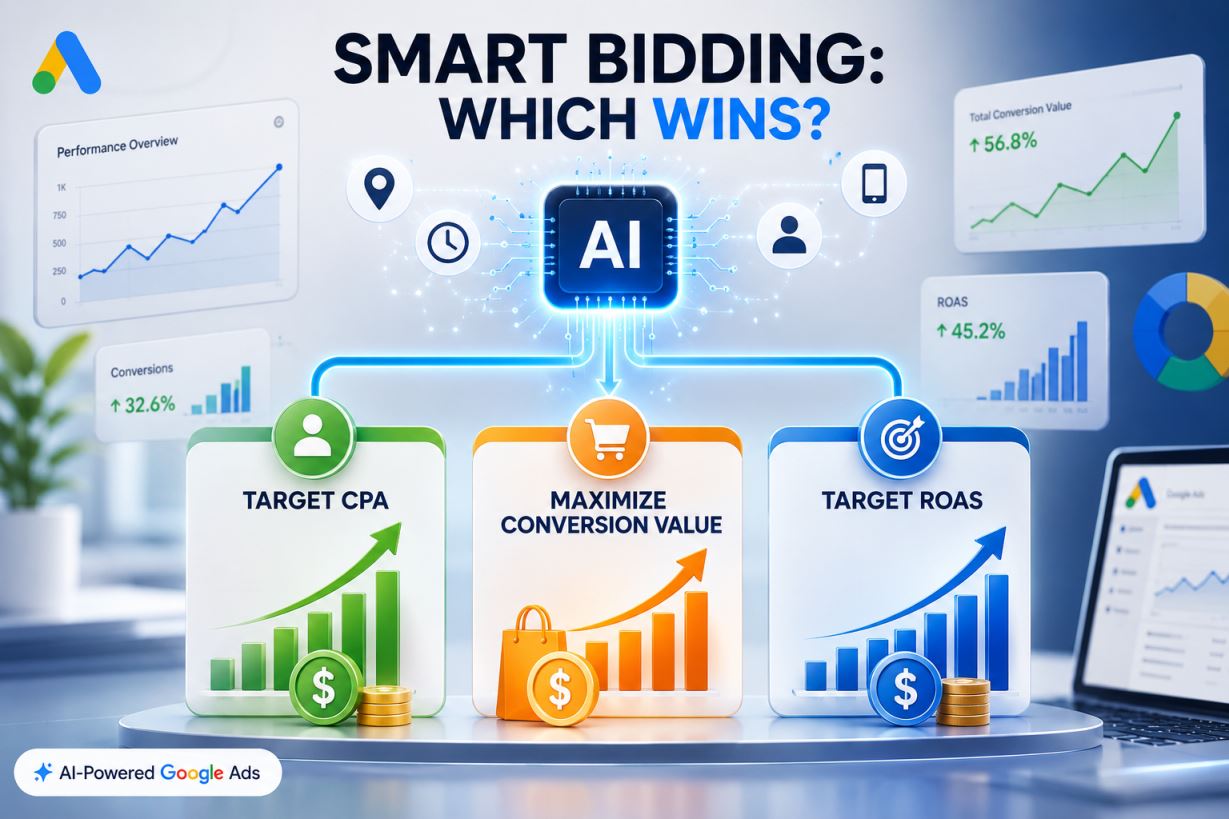
Setting up a beautiful ad and targeting the right audience is only half the battle. The real magic happens when you tell Google exactly how to spend your budget. This is controlled by your bidding strategy, the set of rules the system uses to decide how much to pay for every single ad click.
Years ago, managing campaigns meant manually adjusting bids for every keyword. Today, machine learning handles this through Smart Bidding, analyzing contextual signals like location, time of day, device, and user behavior in real time. But to make the automation work for your business, you need to select the right optimization goal.
Here is a direct comparison of the three most powerful smart bidding strategies and a practical way to test them safely.
Comparing the Big Three Bidding Strategies
Choosing a strategy depends entirely on what your business sells and how you measure success. Let’s break down the primary options available in your marketing toolkit.
1. Target CPA (Cost Per Acquisition)
This strategy focuses on getting you as many leads or customers as possible at a specific target cost that you set. You tell the system: “I want to get a customer inquiry, and I am willing to pay an average of 500 shillings for it.”
How it works: The algorithm dynamically raises your bid when a user matches your historical conversion profile, and lowers it for less relevant traffic, aiming to keep your average cost per lead close to your target.
Best for: Lead-generation businesses, service providers, and companies with a fixed profit margin per sign-up.
2. Maximize Conversion Value
If your products or services have wildly different prices, just tracking the number of leads isn’t enough. You want the system to chase the big wins. Maximize Conversion Value focuses on generating the highest total revenue possible within your daily budget.
How it works: Instead of looking for any conversion, the AI prioritizes high-value users. It uses your historical purchase data to find shoppers likely to fill a large cart or buy your premium packages.
Best for: E-commerce stores with varied product prices or businesses offering tiered, high-value packages.
3. Target ROAS (Return on Ad Spend)
This is the most advanced strategy, where you ask Google to deliver a specific percentage return for every shilling you spend. For example, a 400% Target ROAS means you expect 4,000 shillings in revenue for every 1,000 shillings spent on ads.
How it works: The system predicts the value of a potential conversion before a user even clicks. It will aggressively bid on users likely to bring in massive returns, while avoiding low-value traffic to protect your profit margin.
Best for: Established online stores with high transaction volumes and clean conversion data.
Smart Bidding Exploration: The Safe Way to Test
Switching your entire account to a new bidding strategy overnight can disrupt your steady lead flow while the system adjusts. To avoid this, you should use a process called Smart Bidding Exploration through Google’s Drafts and Experiments tool.
This features allows you to split your campaign traffic right down the middle. For example, 50% of your audience continues to see your stable Target CPA setup, while the other 50% tests Maximize Conversion Value. You can run this trial for a few weeks to compare performance directly before making any permanent changes, ensuring your business stays protected while you find the most profitable setup.
A Quick Tip for Success
Smart bidding relies completely on clean data. Before testing advanced strategies like Target ROAS or Maximize Conversion Value, ensure your conversion tracking is working perfectly and recording accurate monetary values. If the system doesn’t know the financial value of a customer, the automation cannot optimize your bids effectively.