

One of the biggest misconceptions about online advertising is that you need a massive corporate bank account to see real results. Many small and medium enterprises (SMEs) in Kenya pull back from digital advertising because they assume their modest budgets will get swallowed up by larger competitors. In reality, the local digital landscape is highly accessible if you know how to distribute your funds strategically.
When you are managing a lean marketing budget, success is not about outspending the competition; it is about out-smarting them. By understanding local costs and allocating your daily spend across the right campaign types, you can generate consistent leads and grow your customer base efficiently.
Realistic Budget Ranges for Kenyan SMEs
Because Google Ads operates on an auction system rather than a fixed rate card, you have complete control over your daily limits. In the Kenyan market, a typical Cost Per Click (CPC) for mid-range services, retail, or hospitality generally ranges between KES 15 and KES 150. This means entry-level budgets can go a long way.
Depending on your current business stage, here are three realistic starting brackets:
- The Tester Bracket (KES 15,000 to KES 30,000 per month): Breaking down to roughly KES 500 to KES 1,000 per day, this budget is perfect for local service businesses or specialized retail brands wanting to capture high-intent local searches in specific neighborhoods.
- The Growth Bracket (KES 30,000 to KES 60,000 per month): Averaging KES 1,000 to KES 2,000 per day, this level allows you to expand your geographic targeting across major towns like Nairobi, Mombasa, or Kisumu, and start running multi-channel campaigns.
- The Competitive Bracket (KES 60,000 to KES 100,000+ per month): Ideal for fast-moving consumer goods, e-commerce setups, or industries with slightly higher competition like real estate and specialized tours. This level provides enough data for Google’s machine learning engines to optimize quickly.
How to Allocate Your Spend by Campaign Type
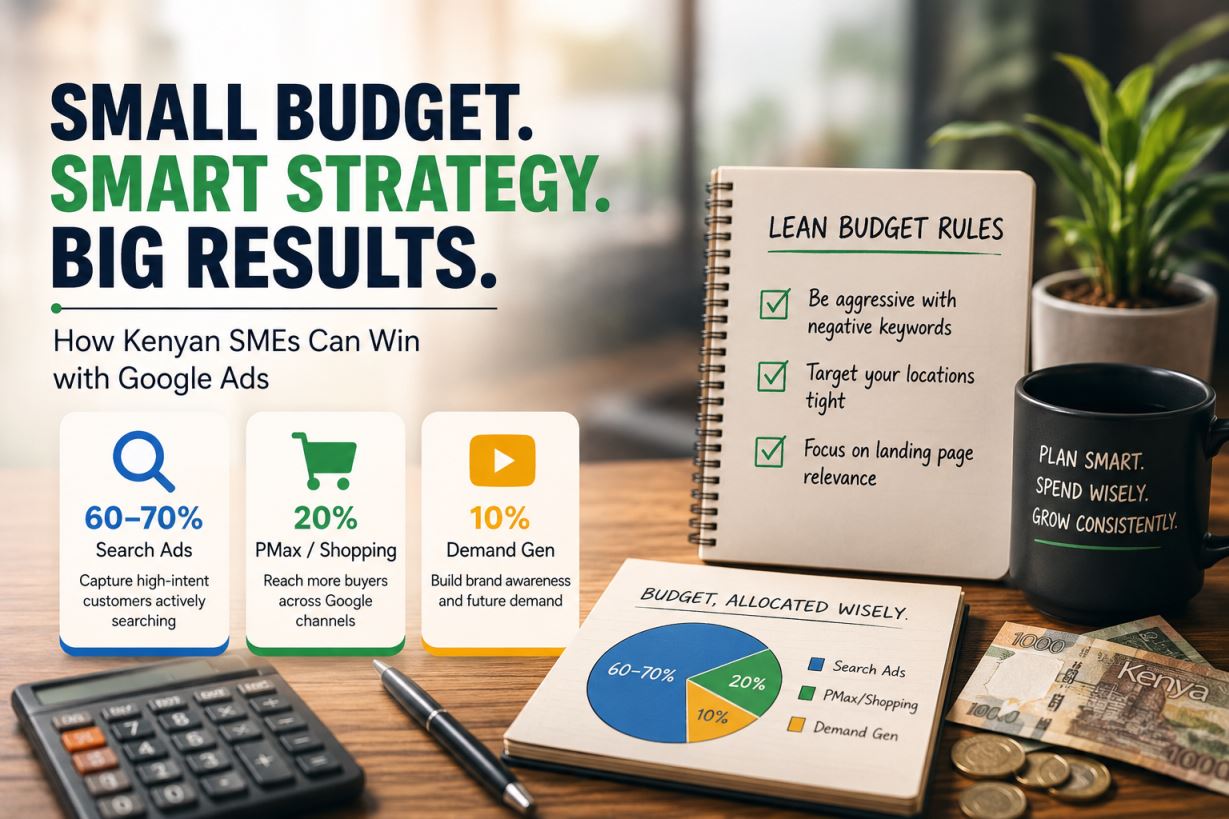
When money is tight, spreading your budget equally across every available ad feature is a recipe for poor performance. You want to prioritize campaigns that sit closest to the actual purchase decision, then use leftover funds to build interest. Here is a balanced framework for a lean budget:
Step 1: Dedicate 60% to 70% to High-Intent Search Ads
The majority of your first advertising shillings should go directly toward capturing existing demand. Google Search ads ensure that when someone explicitly types in a phrase like “private safari operator Kenya” or “vacation rentals in Nyali”, your business appears immediately.
By focusing heavily on exact or phrase-match keywords, you avoid paying for casual browsers and focus your limited funds strictly on prospects who are ready to take action today.
Step 2: Allocate 20% to Performance Max (PMax) or Shopping
If you run an online storefront or have a broad inventory, use a small portion of your budget to fund a conversion-focused automated campaign. Performance Max mixes and matches your text and image assets to find the most cost-effective placements across Maps, Gmail, and the Display Network, ensuring your business stays visible exactly where buyers are looking.
Step 3: Reserve 10% for Demand Gen or Visual Awareness
Use the remaining sliver of your budget to plant seeds for tomorrow. A tiny daily allocation dedicated to a Demand Gen campaign can place engaging images or short video clips directly into YouTube Shorts or Google Discover feeds. This keeps your brand fresh in the minds of local consumers before they even need to search for your services.
Essential Budget Rules for Lean Campaigns
To maximize every single shilling, you need to set up strong guardrails that protect your account from accidental overspending or low-quality clicks. Keep these three core practices in mind:
- Be Aggressive with Negative Keywords: Explicitly block terms that signal a low intent to purchase. Adding phrases like “free”, “cheap”, or “jobs” to your negative keyword list stops your budget from leaking into irrelevant searches.
- Target Your Locations Tight: If your target customer is typically looking for services in specific towns or counties, do not target the entire country. Use radius or city-specific location targeting to focus your budget exactly where your operational strength lies.
- Focus on Landing Page Relevance: Getting a click is only half the job. If an ad promises a specific luxury service, ensure the link takes the user to a page that immediately repeats that exact offer with an obvious button to call or WhatsApp your team. A fast, relevant page drastically drops your overall cost per acquisition.
A Quick Tip for Success
When starting small, patience is your best asset. Google’s bidding systems need consistent conversion data to learn who your ideal customer is. Avoid the temptation to change your budget caps every two days; pick a realistic daily spend, let it run uninterrupted for a few weeks, and make data-backed adjustments once the trends become clear.