
For Kenyan SMEs, this could create opportunities to reach customers you were previously missing.
It could also make poorly structured campaigns more difficult and expensive to manage.
The important point is that September does not mean every Google Search campaign will automatically become AI Max. Google says campaigns using Automatically Created Assets, now called text customization, and campaigns using the campaign-level broad match setting will be automatically upgraded starting in September 2026. The automatic migration of Dynamic Search Ads has been extended to begin in February 2027. Google
What Exactly Is Google AI Max?
AI Max is not a replacement for Search campaigns.
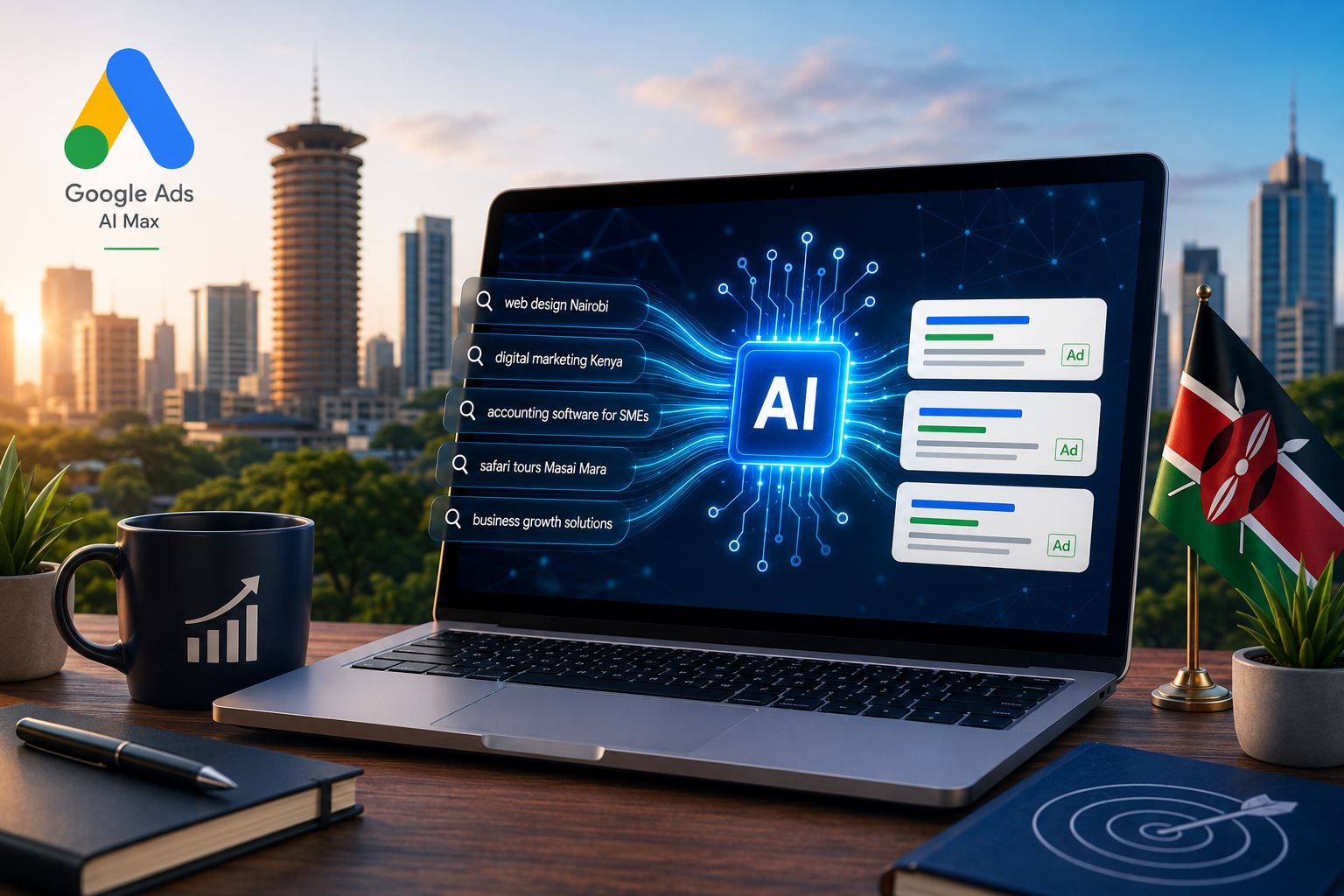
Think of it as an AI optimisation layer added to an existing Search campaign.
It can use signals from your keywords, advertisements, website content and landing pages to determine which searches are relevant and how your ad should be presented. Google Ads Help
Three capabilities are particularly important for SMEs.
1. Broader Search-Term Matching
AI Max can expand beyond the searches you have explicitly targeted.
Google says its search-term matching technology can use broad match, asset-based targeting and keywordless technology to identify relevant queries that existing keyword targeting might miss.
For example, a Kenyan company selling accounting software might traditionally target:
accounting software Kenya
AI-powered matching could potentially identify related searches such as:
- accounting software for small businesses
- bookkeeping software Nairobi
- best invoicing software for SMEs
The opportunity is obvious: customers do not always search using the exact words an advertiser anticipated.
But broader matching also means advertisers need stronger controls.
2. AI-Generated and Customised Ad Messaging
AI Max can use information from existing ads, landing pages and other assets to create customised messaging based on a customer’s search.
Google calls this feature text customization. It was previously known as Automatically Created Assets. The system can generate additional headlines and descriptions using information from the advertiser’s domain, landing pages, existing ads and keywords. Google Ads Help
Instead of relying entirely on the headlines you manually wrote, Google can adapt the message to the searcher’s intent.
That makes the quality of your website and advertising inputs increasingly important.
If your website clearly explains what you sell, who it is for, where you operate and why customers should choose you, Google’s systems have better material to work with.
If your website contains vague, outdated or contradictory information, automation does not magically fix that.
3. Final URL Expansion
AI Max can also identify a more relevant page on your website and send the customer there rather than always sending everyone to the same landing page.
For example, a safari company might have separate pages for:
- Kenya safaris
- Tanzania safaris
- Kenya and Tanzania combined safaris
- Masai Mara safaris
- Family safaris
- Luxury safaris
A search for luxury Masai Mara safari could potentially be directed to a more relevant page than the company’s generic homepage.
That is powerful — but only if the website is organised properly.
Why This Matters Particularly for Kenyan SMEs
Many small businesses still approach Google Ads like this:
Choose keywords → write ads → send traffic to homepage → wait for enquiries.
That model becomes less effective as Google’s systems become more automated.
AI Max puts greater emphasis on the whole advertising ecosystem:
Search intent + keywords + ad messaging + website content + landing pages + conversion data + budget.
This means your website is becoming an increasingly important part of your Google Ads strategy.
A poorly structured website can limit the usefulness of Google’s automation.
A well-structured website gives Google’s systems more useful information about what your business offers.
The Biggest Issue for Small Budgets: More Reach Does Not Mean More Customers
This is where Kenyan SMEs need to be careful.
More searches do not automatically mean more sales.
If you have a KSh 10,000 monthly advertising budget, for example, you cannot afford to pay for large volumes of irrelevant clicks simply because Google’s system has found additional searches.
Google itself notes that AI Max may not be effective when campaigns are limited by budget. Google Ads Help
That does not mean small businesses should automatically avoid AI Max.
It means your campaign needs financially sensible controls before you give automation more freedom.
The objective should not be: “Get more traffic.”
It should be: “Find more of the right potential customers within the budget I can afford.”
What Kenyan SMEs Should Do Before September
1. Audit Your Conversion Tracking
This should be your first priority.
Google’s automated bidding systems depend heavily on conversion data.
If Google is told that every form submission is a valuable conversion, but half those submissions are spam or poor-quality enquiries, the system can learn the wrong lesson.
Review whether you are correctly tracking:
- Contact form submissions
- Phone calls
- WhatsApp enquiries where measurable
- Online purchases
- Booking requests
- Quote requests
- Other important lead-generation actions
For businesses with different levels of customer value, consider whether your conversion setup should distinguish between them.
Newsletter signup ≠ quote request ≠ paying customer.
The better your conversion data, the better automated bidding has a chance of optimising toward business results rather than superficial activity.
2. Clean Up Your Website
This is one of the most overlooked parts of Google Ads.
Before giving AI more control, look at the pages Google might use.
Ask:
- Is the service clearly described?
- Is the location clear?
- Are prices or pricing expectations explained where appropriate?
- Is the target customer obvious?
- Are important services separated into dedicated pages?
- Are old pages still accurate?
- Are there duplicate or thin pages?
- Are there broken links?
- Are pages fast enough?
- Does every important service have a strong call to action?
For example, a Kenyan tour operator should not have one generic “Kenya Safaris” page and expect Google’s systems to understand dozens of different safari products perfectly.
Separate, well-written pages give both customers and Google’s systems stronger signals.
3. Review Your Keyword Strategy
Do not assume AI Max means keywords no longer matter.
Your existing keywords, ads and URLs provide important context for Google’s systems.
Review your current keywords and identify:
High-value searches:
Searches closely connected to customers who can actually buy.
Irrelevant searches:
Queries that consume budget but have little commercial value.
Missing opportunities:
Relevant searches your campaign currently does not reach.
The objective is not necessarily to have hundreds of keywords.
It is to give Google strong signals about what your business actually wants.
4. Build a Serious Negative Keyword List
This becomes increasingly important as targeting becomes broader.
Negative keywords allow advertisers to prevent ads from appearing for searches that do not fit their business objectives.
For example, a company selling professional web design might want to exclude searches involving:
- free website
- website templates
- jobs
- courses
- tutorials
- DIY
- careers
The exact exclusions will depend on the business.
Do not blindly add every unusual search as a negative keyword, though. Some apparently unusual searches may represent valuable customers.
The goal is controlled expansion, not maximum restriction.
5. Review Your Ad Messaging
AI can customise advertising, but that does not mean you should give it a weak foundation.
Review your existing headlines and descriptions.
Make sure they communicate:
- What you offer
- Who you serve
- Where you operate
- Why customers should choose you
- What action they should take
For a Kenyan SME, location can be particularly important.
For example:
Website Design for Kenyan SMEs
is much clearer than:
Grow Your Business Online
Specificity gives both customers and Google’s systems better context.
6. Check Your Landing-Page Structure
If you have multiple services, do not send every Google Ads visitor to your homepage.
A company offering:
- Google Ads management
- SEO
- Website design
- AI training
should ideally have dedicated pages for each major service.
AI Max’s Final URL expansion can use relevant pages on your website when appropriate.
That makes your website architecture part of your advertising infrastructure.
7. Check Your Tracking URLs
There is a less obvious technical issue advertisers should know about.
Google warns that AI Max’s dynamic landing-page functionality can interact badly with some existing tracking templates and potentially result in broken URLs or 404 errors if the tracking setup is not compatible.
If you use custom tracking parameters, third-party tracking systems or complicated URL templates, test them before enabling expanded landing-page functionality.
Do not wait until September to discover that your ads are sending customers to broken pages.
What About AI Overviews in Kenya?
There is another reason Kenyan advertisers should pay attention.
Google says ads can appear above or below AI Overviews in markets where AI Overviews are available.
More significantly, ads within AI Overviews are currently available in English in Kenya, alongside countries including the United States, India, Nigeria and several others. Google Ads Help
That means Google’s search experience is already changing for Kenyan users.
Search is moving from:
“I type keywords → Google gives me links.”
towards:
“I ask a question → Google interprets my intent → AI helps answer it → ads and websites become part of that experience.”
For businesses, this makes relevance increasingly important.
Should Every Kenyan SME Turn On AI Max?
No.
There is no sensible one-size-fits-all answer.
A business with reliable conversion tracking, good landing pages, meaningful conversion volume and enough budget to test the system has a stronger foundation for automation.
A business spending very little, receiving few conversions and struggling with irrelevant traffic should be more cautious.
Google recommends using AI Max alongside conversion-based Smart Bidding and notes that some AI Max features depend on this setup.
So do not treat AI Max as a magic button.
Treat it as an experiment that needs good inputs and measurable outcomes.
The September 2026 Checklist
Before September, a Kenyan SME running Google Search Ads should ideally be able to tick these boxes:
Google Ads Account
- ☐ I know whether my campaigns use Automatically Created Assets/text customization.
- ☐ I know whether campaign-level broad match is enabled.
- ☐ I know which campaigns may be automatically upgraded.
- ☐ I have reviewed my current campaign structure.
- ☐ I have reviewed my search terms.
Conversion Tracking
- ☐ Important leads are being tracked.
- ☐ Poor-quality actions are not being treated as valuable conversions.
- ☐ Phone calls are tracked where relevant.
- ☐ Sales or booking values are captured where practical.
- ☐ Conversion data is being used by the bidding strategy.
Website
- ☐ Important services have dedicated pages.
- ☐ Landing pages accurately describe the offer.
- ☐ Pages have strong calls to action.
- ☐ Outdated and broken pages have been cleaned up.
- ☐ Tracking URLs have been tested.
- ☐ The website works well on mobile.
Campaign Controls
- ☐ Negative keywords have been reviewed.
- ☐ Location targeting is correct.
- ☐ Brand controls have been reviewed.
- ☐ Budget limits are understood.
- ☐ Search-term performance is being monitored.
Another Google Ads Change Kenyan Businesses Should Not Ignore
September is not the only date advertisers should have on their radar.
Starting August 17, 2026, Google is changing how certain target-based bidding strategies behave when campaigns are constrained by budget.
The change affects campaigns using target-based bidding strategies such as Target CPA and Target ROAS. Google says affected campaigns may experience temporary performance and traffic fluctuations as the bidding system is updated.
Google recommends reviewing affected campaigns, particularly those that are “Limited by budget” and performing better than their stated targets, before August 17.
Google also says it will not automatically change advertisers’ budgets or bid targets. Google Ads Help
For SMEs operating on tight budgets, this makes August and September a particularly good time to review Google Ads accounts rather than simply letting campaigns run untouched.
The Bigger Lesson for Kenyan Business Owners
AI Max is not really about giving Google more control.
It is about whether your business has given Google enough good information to use that control intelligently.
Your website needs to be clear.
Your conversion tracking needs to be trustworthy.
Your campaigns need sensible boundaries.
Your negative keywords need to protect your budget without blocking valuable opportunities.
And your advertising budget needs to be large enough to support the strategy you are asking Google to execute.
The businesses most likely to benefit from Google’s increasing automation will not necessarily be the businesses with the biggest advertising budgets.
They will be the businesses with the clearest offers, cleanest data, strongest websites and best understanding of their customers.
That is the preparation Kenyan SMEs should focus on before September.
Bottom Line
Do not panic about AI Max. Prepare for it.
If your Google Ads account is already producing quality conversions, AI Max may give Google more ways to discover and convert relevant customers.
If your campaigns currently generate irrelevant clicks, poor leads or weak conversion data, turning on more automation will not solve the underlying problem.
Fix the foundation first. Then let the AI do more of the optimisation.
Frequently Asked Questions
What is Google AI Max?
AI Max is a suite of AI-powered targeting and creative features that operates within Google Search campaigns. It can expand search-term matching, customise ad assets and expand landing-page selection.
Is AI Max a new Google Ads campaign type?
No. AI Max is an optimisation layer for existing Search campaigns, not a completely separate campaign type.
Will every Google Search campaign automatically switch to AI Max in September 2026?
No. Google says campaigns using Automatically Created Assets/text customization and campaigns using the campaign-level broad match setting will be automatically upgraded starting in September 2026. The automatic migration of Dynamic Search Ads has been extended to February 2027.
Should small businesses use AI Max?
It depends on the campaign. Businesses should first make sure they have reliable conversion tracking, strong landing pages, appropriate campaign controls and a realistic budget. AI Max should be tested based on business outcomes rather than simply increased traffic.
Will AI Max increase my Google Ads budget?
AI Max does not by itself mean that Google can exceed your configured campaign budget. However, broader targeting can change where your budget is spent, which is why search-term monitoring and conversion tracking remain important.
Are Google Ads in AI Overviews available in Kenya?
Yes. Google currently lists Kenya among the countries where ads within AI Overviews are available in English on mobile and desktop devices.
Sources
- Google: We’re upgrading Dynamic Search Ads to AI Max
- Google Ads Help: How AI Max for Search campaigns works
- Google Ads Help: About text customization in Search campaigns
- Google Ads Help: About the broad match keywords campaign setting
- Google Ads Help: About ads and AI Overviews
- Google Ads Help: Changes to target-based bid strategies
Editor’s note: Google performance figures cited in this article are Google’s own reported data and should be treated as vendor-reported claims rather than independent verification.