

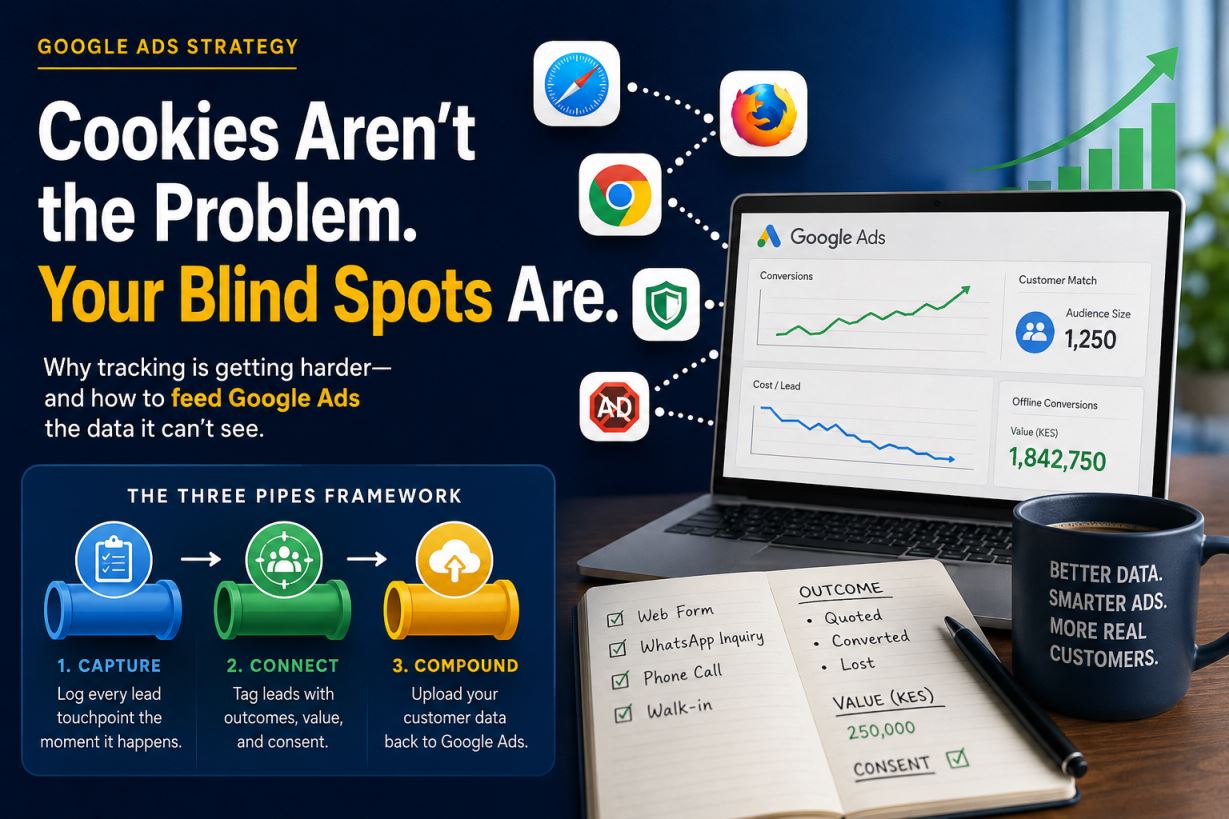
Somebody told you cookies are dying. However, Google reversed its own deprecation plan back in 2024, after four years of promising to kill them off, and Chrome still uses third-party cookies today.
Here’s what nobody tells you, it doesn’t matter. Safari and Firefox already block third-party cookies by default, which means roughly half the web has been invisible to standard ad tracking for years. Chrome now lets each user choose, and a growing share of them choose privacy. Your Google Ads account isn’t losing signal because of one dramatic cutoff date. It’s losing signal quietly, browser by browser, user by user, and most business owners haven’t noticed because the drop doesn’t show up as a cliff. It shows up as your cost per lead creeping up for reasons the dashboard won’t explain.
So What’s Actually Happening to Your Tracking Data?
Three things, at once. Safari and Firefox users were never trackable by third-party cookies to begin with. A rising share of Chrome users are opting out through browser privacy settings. And every ad blocker installed on a customer’s phone quietly deletes a data point Google Ads was counting on.
None of this means “stop running ads.” It means the account is increasingly blind to what happens after the click, especially for businesses whose real conversion doesn’t happen on the website at all.
Why This Hits You Harder Than the Case Studies You’ve Read
Most cookie-deprecation content is written for e-commerce brands where the sale closes on-site: add to cart, checkout, done. Google Ads can still see that.
Kenyan B2B and service businesses don’t work that way. Someone clicks your ad, WhatsApps a question, gets a quote by phone three days later, and pays via bank transfer a week after that. None of that lives in a cookie. None of it was ever going to.
That’s the real problem, not that cookies vanished, but that your highest-value conversions were never cookie-trackable in the first place. You’ve been feeding Google Ads incomplete information since before “cookie deprecation” was a headline. The browser changes just made the gap harder to ignore.
The Three Pipes: A Framework for Feeding Google Ads What It Can’t See on Its Own
If Google Ads can’t observe your real conversions, you have to hand them over. That’s what “first-party data” means in practice, not a buzzword, a pipeline. Call it the Three Pipes, because each one fails independently, and most businesses only build one.
Pipe 1: Capture. Every lead touchpoint gets logged somewhere structured, the moment it happens: web form, WhatsApp inquiry, phone call, walk-in. If it’s sitting in someone’s WhatsApp chat history instead of a spreadsheet or CRM, it isn’t captured. It’s just a memory.
Pipe 2: Connect. Captured leads get tagged with an outcome, quoted, converted, lost, value in shillings, and consent to be contacted is recorded alongside them. A list without outcomes is a contact list, not an audience.
Pipe 3: Compound. The connected, consented list gets uploaded back into Google Ads on a schedule, weekly or monthly, not once and forgotten, so the algorithm keeps learning who your actual buyers look like, not just who clicked.
Skip Pipe 1, and you have nothing to upload. Skip Pipe 2, and you’re uploading noise. Skip Pipe 3, and you’ve built a beautiful spreadsheet that Google Ads will never see.
What “Feeding Google Ads” Actually Means, Technically
Two mechanisms do the work.
Offline conversion imports let you tell Google Ads which clicks eventually turned into paying customers, including the ones that closed over the phone days later, with the real transaction value attached.
Customer Match lets you upload a list of your actual customers (as hashed emails or phone numbers) so Google Ads can find more people who look like them.
Both need volume to work well. Customer Match in particular has a minimum list size before it activates targeting around 1,000 matched users. If your pipeline produces a handful of leads a month, you’re not there yet, and that’s worth knowing before you invest engineering time into automating an upload for a list too small to matter.
The Honest Limits Nobody Selling This Will Tell You
This isn’t instant, and it isn’t free of trade-offs.
Data quality beats data quantity. A clean list of 300 real customers with confirmed emails outperforms a scraped list of 3,000. Consent isn’t optional; uploading contacts who never agreed to be marketed to is the kind of shortcut that gets accounts flagged, not just customers annoyed. And the payoff is gradual: expect weeks of consistent uploads before Google Ads’ targeting visibly improves, not a same-week jump in performance.
If your business genuinely closes fewer than 20–30 leads a month, building Pipes 1 and 2 properly still matters, but don’t expect Pipe 3 to move your Google Ads results much until volume grows.
What This Looks Like in Your First 30 Days
Start smaller than you think. Pick one lead source, your WhatsApp Business inquiries, say, and log every conversation into a simple spreadsheet with three columns: contact, source, outcome. Do that for three weeks before touching Google Ads at all.
That spreadsheet is Pipe 1. It’s unglamorous, and it’s the entire foundation everything else sits on. Businesses that skip straight to “let’s set up Customer Match” without this step end up automating an empty pipe.
Where This Actually Pays Off
Cookies were never the real issue for a WhatsApp-and-phone-call sales process. The real issue is that most businesses have been running Google Ads with one eye closed, unable to tell the algorithm which clicks actually turned into money. Fixing that isn’t a privacy-compliance chore. It’s the difference between an account that spends your budget guessing and one that spends it knowing.
If your business does more than roughly Ksh500,000 a month in marketing spend and you’re not sure whether your real conversions are making it back into Google Ads, that’s a specific, fixable gap, not a browser problem.
Contact Us for a free Google Ads Audit
Frequently Asked Questions
Are third-party cookies actually gone in 2026?
No. Google abandoned its forced deprecation plan in 2024 and now lets Chrome users choose whether to allow them. Safari and Firefox have blocked third-party cookies by default for years, which is why a large share of web traffic has already been untrackable regardless of what Chrome decides.
What’s the difference between Customer Match and offline conversion imports?
Offline conversion imports tell Google Ads which past clicks led to a real sale, including sales that closed off-site. Customer Match uploads a list of known customers so Google Ads can find more people similar to them. Most businesses need both, not one or the other.
How many leads do I need before this is worth setting up?
The processes of capturing and tagging leads are worth doing at any volume. Uploading that data to actively improve Google Ads targeting through Customer Match generally needs a larger list to activate. Very low-volume businesses should focus on building the habit first.
Is uploading customer contact data to Google Ads legal in Kenya?
This isn’t legal advice, but the general principle under Kenya’s Data Protection Act is the same one Google requires: you need documented consent to use someone’s contact details for marketing, including uploading it to an ad platform.