
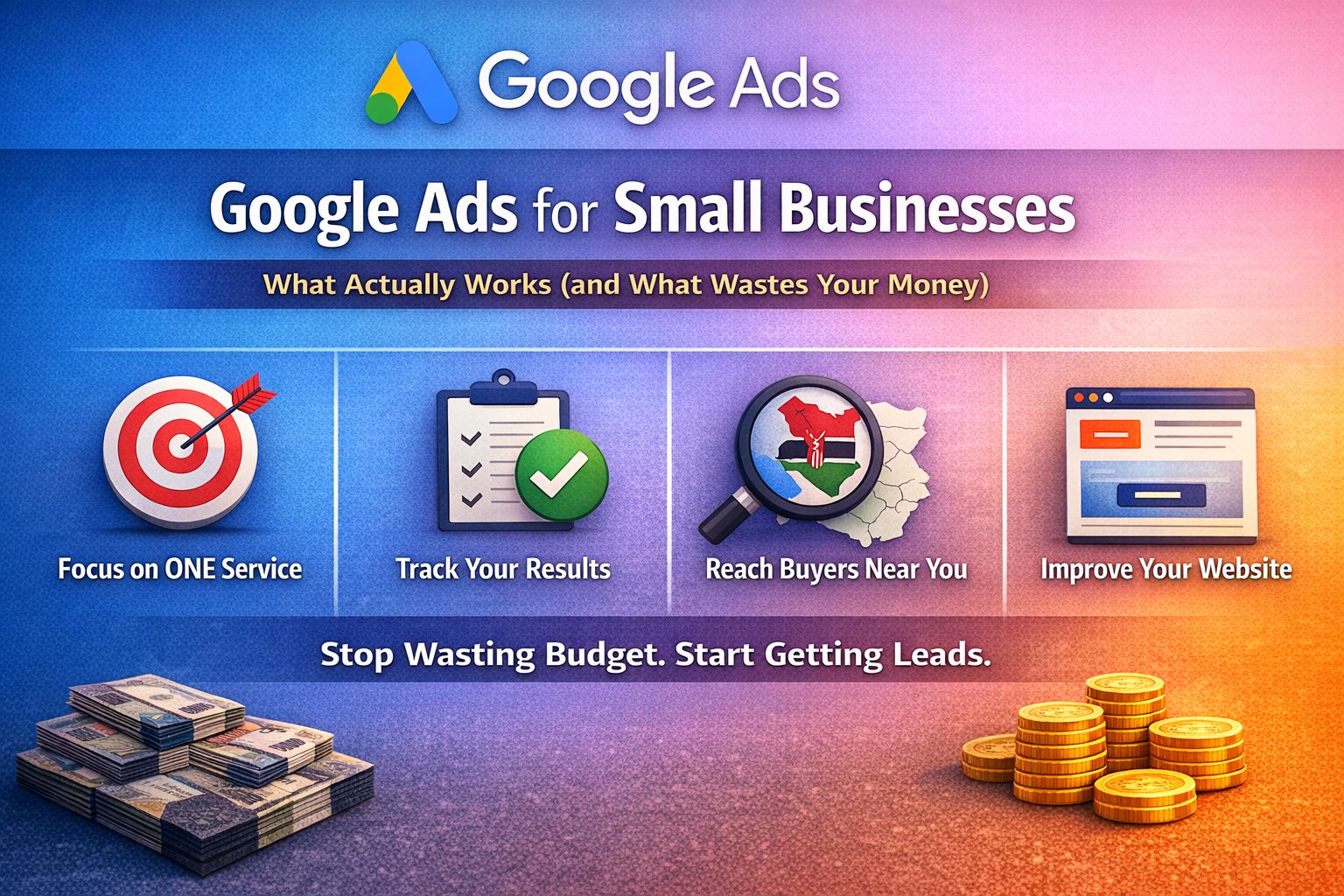
Many small business owners try Google Ads once, lose money, and conclude: “Google Ads doesn’t work.”
In reality, Google Ads does work—but only when it’s set up with focus, intent, and the right expectations.
This article breaks down what actually works for small businesses using Google Ads today, and the most common reasons budgets get burned with nothing to show for it.
The Hard Truth About Google Ads for Small Businesses
- Google Ads is not a branding tool.
- It is not a visibility experiment.
- And it is definitely not a “boost everything” platform.
Google Ads works best when:
- You sell something people are already searching for
- You can clearly define who you want
- You measure real business actions, not clicks
If any of those are missing, results suffer—fast.
Mistake #1: Advertising Too Many Things at Once
This is the number one budget killer.
Small businesses often try to:
- Advertise all services
- Cover multiple locations
- Target many keywords
- Run several campaigns at once
- With a limited budget, this spreads your data too thin.
What works instead
Focus on:
- One core service
- One clear location
- One primary conversion goal
This gives Google’s system enough data to learn and optimize.
Focus beats variety every time.
Mistake #2: Paying for Clicks Without Tracking Results
Clicks are not success.
Traffic is not revenue.
If you are paying for ads but not tracking:
- Phone calls
- Form submissions
- WhatsApp clicks
- Booking actions
…then Google has no idea what “success” looks like for your business.
What works instead
Set up proper conversion tracking so Google learns which searches bring real customers, not just visitors.
No tracking = no learning
No learning = wasted budget
Mistake #3: Chasing Cheap Clicks Instead of Serious Buyers
Many advertisers try to lower costs by targeting:
- Very broad keywords
- Informational searches
- Generic terms with no buying intent
This usually leads to:
- High traffic
- Low conversions
- Frustration
What works instead
Target high-intent searches, even if they cost more.
Examples:
- “plumber near me”
- “Google Ads consultant Nairobi”
- “emergency electrician Mombasa”
Fewer clicks.
Better leads.
Higher ROI.
Google Ads Has Changed: Keywords Matter Less Than Signals
In recent years, Google Ads has shifted from pure keyword matching to signal-based targeting.
Today, Google considers:
- Location
- Search intent
- Device behavior
- Landing page clarity
- Past conversion data
This means you don’t win by having the longest keyword list.
You win by having clarity.
Clear offer.
Clear audience.
Clear action.
The Landing Page Matters More Than Most People Think
Sending traffic to:
- Your homepage
- A cluttered page
- A slow page
- A page with no clear call-to-action
…will quietly kill performance.
What works instead
Your landing page should answer three questions immediately:
- What do you offer?
- Who is it for?
- What should the visitor do next?
If the page is confusing, Google Ads cannot save it.
What a Simple, Effective Google Ads Setup Looks Like
For most small businesses, a strong starting setup is:
- One Search campaign
- One service
- One location
- One conversion goal
- Tight keyword focus
- Clear landing page
This setup:
- Learns faster
- Wastes less money
- Is easier to optimize
Complexity is earned after results—not before.
Final Thought: Google Ads Is a Business Tool, Not a Gamble
Google Ads rewards:
- Focus
- Patience
- Measurement
- Clear thinking
It punishes:
- Guesswork
- Over-expansion
- Poor tracking
- Weak offers
If your ads “didn’t work before,” that doesn’t mean they won’t work now.
It usually means the strategy needs tightening—not abandoning.
