
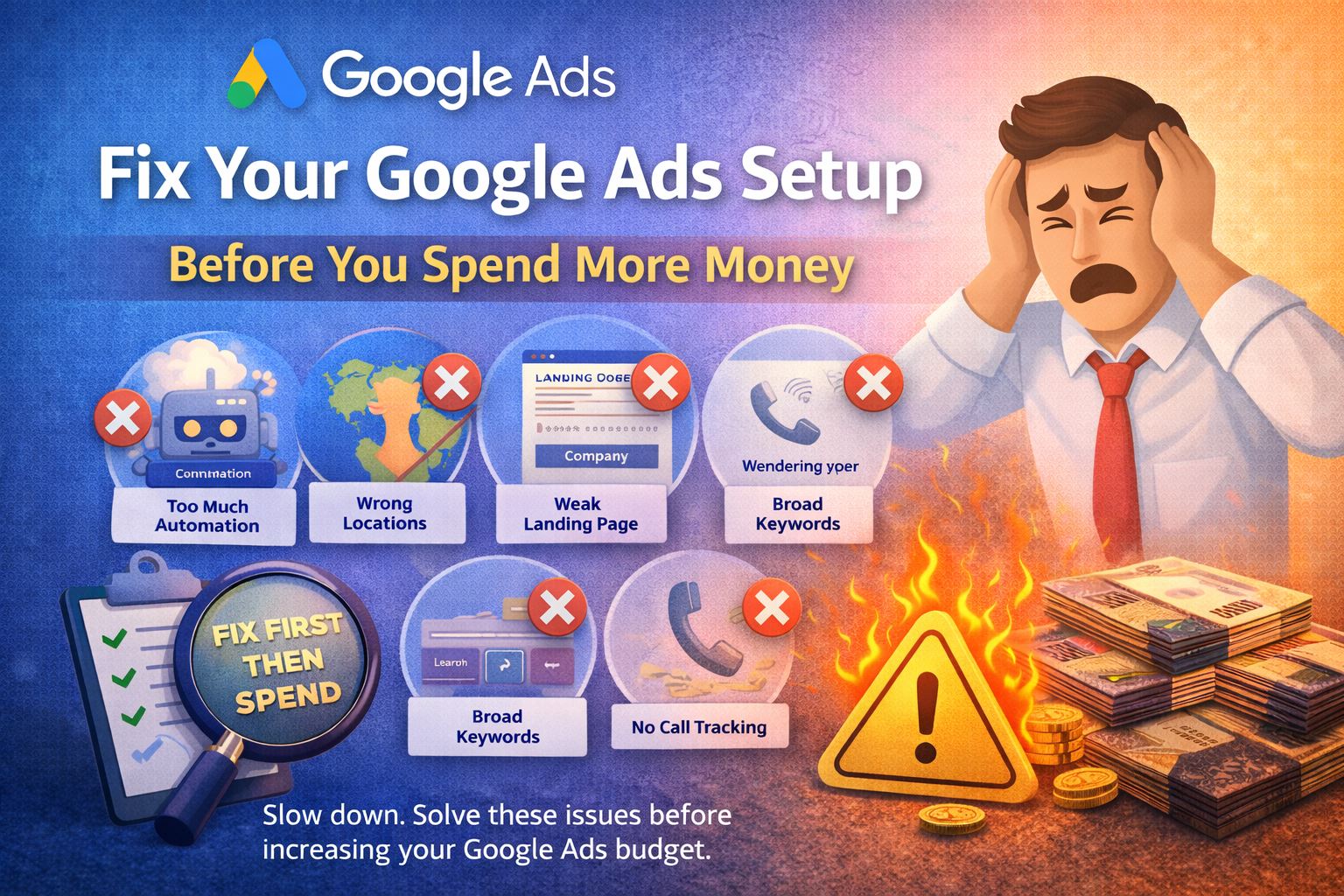
Many small business owners don’t fail at Google Ads because of low budgets.
They fail because they scale a broken setup.
Increasing spend on a poorly structured Google Ads account doesn’t fix performance—it simply accelerates waste. Before adding even one shilling to your budget, your setup needs to be clean, focused, and measurable.
This article walks you through the core Google Ads setup checks every small business must get right before scaling.
The Costly Mistake: Spending More Instead of Fixing First
When ads don’t generate enquiries, the common reaction is:
“Maybe I need to increase the budget.”
In reality, if Google doesn’t clearly understand:
- who your customer is
- what action matters
- where you operate
…then more spend just feeds the algorithm confusion.
Google Ads rewards clarity, not impatience.
Setup Issue #1: No Clear Conversion Tracking
If Google Ads cannot see what a “good result” looks like, it cannot optimise.
Many small businesses track:
- clicks
- impressions
- traffic
But fail to track:
- phone calls
- form submissions
- WhatsApp clicks
- bookings
Why this matters
Google’s bidding system learns from conversions, not clicks.
No tracking = no learning.
Before spending more, ensure at least one primary conversion is set up correctly.
Setup Issue #2: Advertising Too Broadly
A common setup looks like this:
- Multiple services
- Wide geographic coverage
- Broad keywords
- One generic landing page
This dilutes performance, especially on small budgets.
What works better
Start narrow:
- One main service
- One clear location
- One strong offer
- One clear action
Focus gives Google clean signals. Clean signals reduce waste.
Setup Issue #3: Letting Google Decide Everything Too Early
Automation is powerful—but only after your account has data.
Many small advertisers:
- turn on automated bidding immediately
- use broad match keywords
- rely on Google to “figure it out”
With little data, Google guesses. Guessing is expensive.
The smarter approach
- Start controlled
- Review search terms
- Add negative keywords early
- Tighten targeting first
Automation works best when guided.
Setup Issue #4: Ads Running When You Can’t Convert
If your ads run:
- outside business hours
- in areas you don’t serve
- when calls go unanswered
…you are paying for traffic that cannot convert.
Before scaling, confirm:
- correct locations
- correct schedules
- correct devices (if relevant)
Small adjustments here can dramatically improve results.
Setup Issue #5: Weak or Confusing Landing Pages
Even a perfect ad cannot save a poor page.
- Common problems:
- Sending traffic to the homepage
- No clear call-to-action
- Too many distractions
- Slow loading times
Your landing page must answer immediately:
- What do you offer?
- Who is it for?
- What should I do next?
If this isn’t obvious, conversions drop—and costs rise.
The Rule to Remember Before Scaling
Never scale spend before fixing structure.
A healthy Google Ads account has:
- Clear conversion tracking
- Focused targeting
- Controlled keywords
- Relevant landing pages
- Clean data signals
Once these are in place, scaling becomes strategic—not risky.
Final Thought
Google Ads is not a gamble.
It’s a system.
When the system is clear, results follow.
When it’s messy, money leaks.
Before increasing your budget this week, fix the setup first.
