

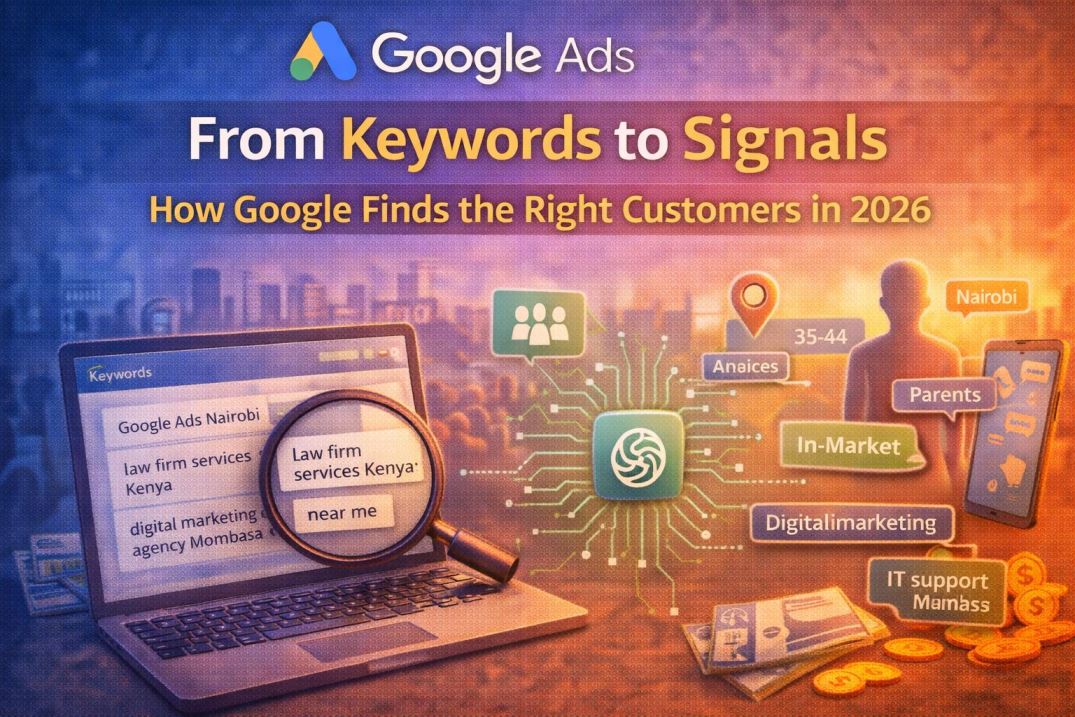
For many years, Google Ads revolved around one central concept: keywords. Advertisers would select specific phrases they believed potential customers might search, and their ads would appear when those keywords were triggered.
While keywords are still important today, the way Google finds potential customers has evolved significantly. In 2026, Google Ads relies far more on signals, which are a complex mix of user behavior, demographics, intent, and contextual data to determine which ads should appear and who is most likely to convert.
Understanding this shift from keywords to signals is essential for businesses that want to run effective campaigns in today’s advertising environment. Companies that adapt to this new model will gain a competitive advantage, while those relying solely on old keyword strategies may struggle to keep up.
In this article, we’ll explore how Google now uses signals to identify high-intent users, why this matters for advertisers, and how businesses can adapt their strategies accordingly.
The Traditional Role of Keywords in Google Ads
Historically, Google Ads campaigns were built primarily around keyword targeting.
Advertisers would research keywords such as:
- “digital marketing agency Nairobi”
- “accounting services for small business”
- “property for sale in Mombasa”
When a user typed one of these phrases into Google, the search engine matched the query with relevant ads.
This keyword-driven system worked well when search behavior was relatively simple. However, user behavior has become far more complex. People now search using voice assistants, mobile devices, conversational queries, and incomplete phrases.
As a result, relying solely on keywords no longer provides enough context to accurately predict user intent.
The Rise of Signals in Google Advertising
To improve ad performance and relevance, Google has increasingly shifted toward signal-based targeting.
Signals are pieces of information that help Google understand who a user is, what they might want, and how likely they are to take action.
These signals include factors such as:
- User demographics
- Location
- Device type
- Search behavior
- Past browsing patterns
- Time of day
- Interests and intent
By analyzing these signals together, Google can determine which users are most likely to convert, even if their search query does not exactly match an advertiser’s chosen keywords.
For advertisers, this means the algorithm is becoming less about matching words and more about understanding people.
How Google Uses Demographic Signals
One of the most important signals Google uses is demographic data.
This includes characteristics such as:
- Age group
- Gender
- Household income (in certain regions)
- Parental status
- Life events
For example, if someone searches for “international schools near me”, Google may prioritize showing ads to users who are more likely to have children.
Similarly, a search for “luxury apartments in Nairobi” might prioritize users within higher income brackets or those who have previously shown interest in premium real estate.
While advertisers may still target keywords, demographic signals help Google refine which users see those ads.
This improves both ad relevance and conversion rates.
Contextual Signals – Understanding the Situation
Context plays a crucial role in modern search advertising.
Google considers a wide range of contextual signals, including:
- The user’s current location
- Whether the search is happening on mobile or desktop
- The time of day
- The user’s recent activity
For instance, a search for “coffee shop near me” at 8:00 AM likely indicates immediate intent. In contrast, the same search at midnight might trigger different results.
Similarly, someone searching “IT support services” during working hours from a corporate office network may be more likely to represent a business decision-maker.
These contextual signals allow Google to deliver ads that are not only relevant to the search query but also aligned with the user’s immediate situation.
Why This Matters for Businesses in 2026
For businesses running PPC campaigns, this shift toward signals has several important implications.
1. Campaigns Must Provide Clear Conversion Signals
Google’s algorithms rely heavily on conversion data to learn which users are most likely to become customers.
If conversion tracking is missing or inaccurate, the system has fewer signals to optimize against.
Businesses should ensure they are properly tracking actions such as:
- form submissions
- purchases
- phone calls
- booking requests
The more accurate the conversion data, the better Google can refine its targeting.
2. Audience Signals Are Becoming More Important
Advertisers can now provide audience signals to guide Google’s learning process.
Examples include:
- remarketing audiences
- website visitors
- customer lists
- in-market audiences
These signals help Google understand which types of users are valuable for your business.
Rather than targeting only keywords, advertisers are increasingly targeting types of people.
3. Automation Is Driving Performance
Modern Google Ads campaigns rely heavily on automation and machine learning.
Campaign types such as:
- Performance Max
- Smart bidding strategies
- Responsive search ads
all rely on signals to optimize performance.
Instead of manually controlling every keyword bid, advertisers provide data and signals while Google’s system identifies patterns that lead to conversions.
This allows campaigns to scale more efficiently.
The Role of First-Party Data
Another major shift in digital advertising is the increasing importance of first-party data.
With third-party cookies becoming less reliable, businesses must rely more on data collected directly from their customers.
First-party data may include:
- email subscriber lists
- CRM data
- website visitor behavior
- customer purchase history
This data provides powerful signals that help Google identify similar audiences and deliver ads to users who resemble existing customers.
Businesses that build strong first-party data strategies will have a major advantage in the evolving advertising landscape.
Keywords Still Matter, But They Are Only the Starting Point
Despite the shift toward signals, keywords are still an important foundation.
They help Google understand what your business offers and which searches are relevant.
However, the role of keywords is evolving.
Instead of acting as strict triggers, they now serve as starting points that guide the algorithm, which then uses signals to refine targeting.
Advertisers who combine strong keyword research with rich signals will achieve the best results.
Conclusion
Google Ads in 2026 is no longer just about matching keywords with search queries. It is about understanding user intent, behavior, and context.
Signals, including demographics, location, browsing behavior, and first-party data, help Google identify the users most likely to convert.
For businesses, this means that successful campaigns require more than keyword lists. They require:
- accurate conversion tracking
- strong audience signals
- high-quality first-party data
- and strategic use of automation
By embracing this shift from keywords to signals, advertisers can build campaigns that are smarter, more efficient, and better aligned with how modern search works.
Businesses that understand this transformation today will be better positioned to succeed in the future of digital advertising.